
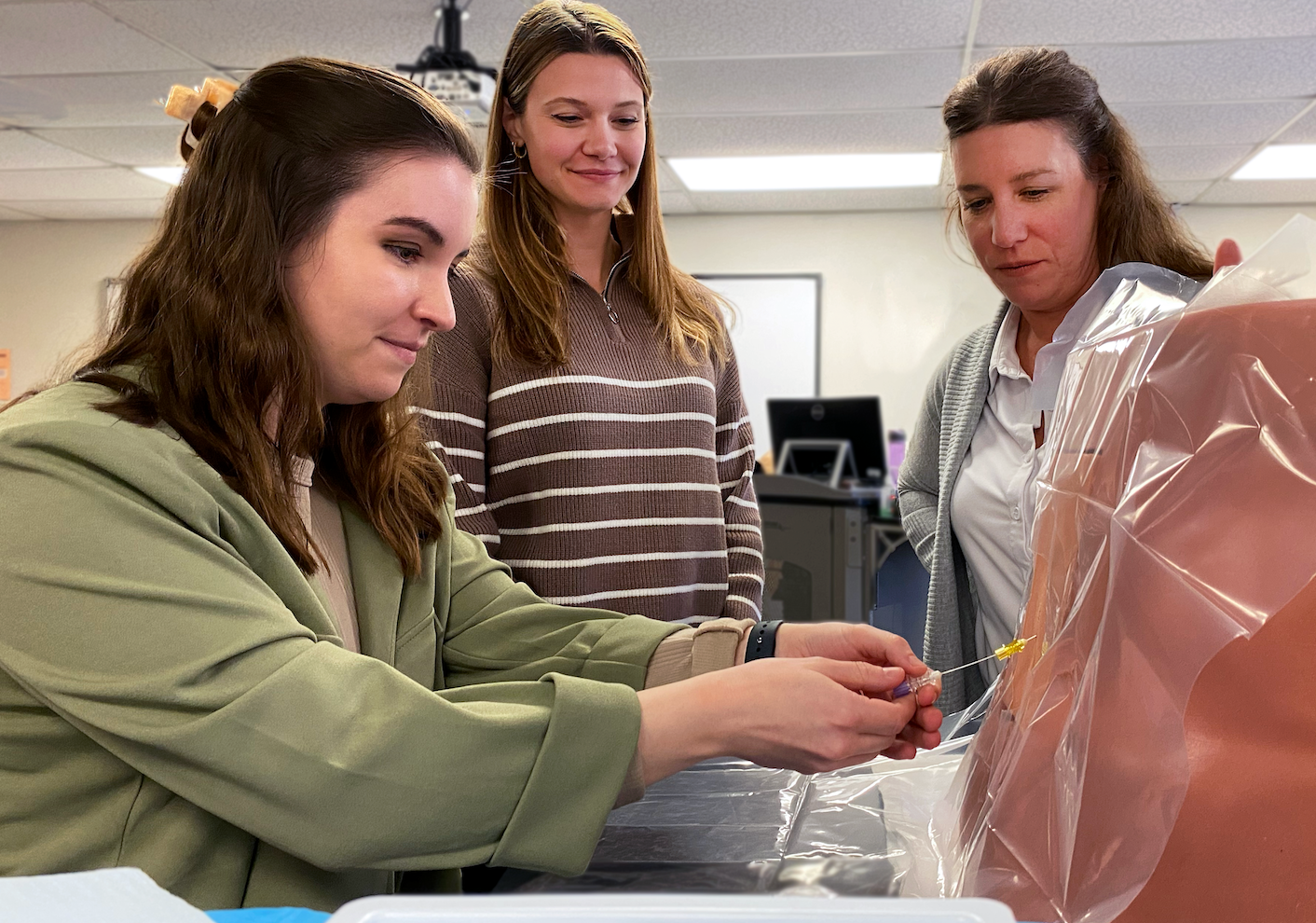
Nurse Anesthesia Program
Doctorate in Nursing Practice
Lourdes University’s Doctor of Nursing Practice Nurse Anesthesia Program (DNP-NAP) seeks to provide the highest quality doctoral education to prepare competent Certified Registered Nurse Anesthetists (CRNAs) in the areas of clinical practice, education, leadership, and research.
Lourdes University’s Doctor of Nursing Practice Nurse Anesthesia Program (DNP-NAP) prepares graduates for specialization as a Certified Registered Nurse Anesthetist (CRNA). The program integrates demanding coursework in DNP and nurse anesthesia specialty classes with exceptional clinical residencies over 36 months of full-time study.
Throughout the nine-semester program, we foster opportunities for each student to develop the essential skills required for clinical competence as a nurse anesthetist. Upon successful completion of the program, graduates are prepared to take the National Board of Certification and Re-certification for Nurse Anesthetists (NBCRNA) certification exam, leading to the designation of CRNA.
The Lourdes DNP-NAP is accredited by the Council on Accreditation of Nurse Anesthesia Programs (COA).
Visit the COA website at www.coacrna.org.
Contact the COA directly at 224-275-9130 or via 10275 W. Higgins Rd., Suite 906, Rosemont, IL 60018-5603.
For more information, please contact:
Cynthia Prusaitis at CPrusaitis@lourdes.edu.
Plan of Study
DNP NURSE ANESTHESIA PROGRAM CURRICULUM
Curriculum
Total: 97 credit hours
PREREQUISITES OFFERED THROUGH LOURDES UNIVERSITY:
Scientific Writing Course
Theory & Philosophy for Advanced Practice Nursing
Graduate Statistics
Catalog 2023-2024/2024-2025/2025-2026
Summer Year 1
NUR 711 Scientific Foundations for Anesthesia
NUR 720 Translational Research for Advanced Practice (DNP Core Course)
NUR 735 Epidemiology (DNP Core Course)
NUR 745 Leadership and Economic Concepts for Advanced Nursing (DNP Core Course)
Fall Year 1
NUR 707 Advanced Pharmacology for APRN
NUR 712 Advanced Human Anatomy
NUR 718 Advanced Physiology and Patho Across the Lifespan I
NUR 723 Foundational Principles of Quality Management for Leading Change (DNP Core Course)
NUR 721 Principles for DNP Anesthesia I
Spring Year 1
NUR 708 Advanced Pharmacology for Anesthesia II
NUR 713 Advanced Health Assessment & Diagnostic Reasoning
NUR 719 Advanced Physiology and Path Across the Lifespan II
NUR 726 DNP Anesthesia Residency I
NUR 729 Principles for DNP Anesthesia II
Summer Year 2
NUR 730 Advocacy and Social Policy (DNP Core Course)
NUR 736 DNP Anesthesia Residency II
NUR 738 Population Health for Advanced Nursing (DNP Core Course)
NUR 739 Principles for DNP Anesthesia III
Fall Year 2
NUR 744 Regional Anesthesia and Pain Management
NUR 746 DNP Anesthesia Residency III
NUR 749 Principles for DNP Anesthesia IV
NUR 750 DNP NAP Project 1 – Problem Identification and Literature Review (DNP Core Course)
Spring Year 2
NUR 754 DNP NAP Project 2 – Project Planning (DNP Core Course)
NUR 756 DNP Anesthesia Residency IV
Summer Year 3
NUR 755 DNP NAP Project 3 – Project Implementation (DNP Core Course)
NUR 766 DNP Anesthesia Residency V
Fall Year 3
NUR 760 NAP Project 4 – Project Evaluation and Dissemination (DNP Core Course)
NUR 763 Synthesis of Critical Anesthesia Concepts
NUR 768 DNP Anesthesia Residency VI
Spring Year 3
NUR 764 Synthesis of Critical Anesthesia Concepts
NUR 770 DNP Anesthesia Residency VII
Learning Outcomes
Nurse Anesthesia Program (NAP) Outcomes
The student will:
- Apply scientific knowledge and psychomotor ability while providing anesthesia care.
- Demonstrate safety and vigilance to protect the patient from harm.
- Provide individualized and holistic anesthesia care to meet the needs of the patient.
- Demonstrate effective oral and written communication skills.
- Demonstrate professionalism and responsibility in the advanced practice role of the nurse anesthetist.
- Utilize critical thinking and decision-making skills to impact patient care.
Doctorate in Nursing Practice (DNP) Program Student Learning Outcomes
The student will:
- Display a professional commitment to the Franciscan values of community, learning, reverence, and service when leading care of diverse populations in the advanced practice nursing role.
- Utilize interdisciplinary sciences to establish professional standards that provides safe, effective, efficient evidence-based care in an advanced practice nursing role.
- Apply evidence-based knowledge in the design and use of theoretical and technological systems to manage individual and aggregate level information to improve and transform healthcare.
- Employ communication, leadership, and cultural principles to collaborate with multidisciplinary teams in the provision of quality and safety initiatives to improve outcomes at the individual and systems level.
- Utilize epidemiology to translate evidence-based practice models to improve individual aggregate and population health.
- Synthesize, evaluate, and discuss impact of ethical, political, economic, legal, and more issues as related to healthcare in society.
Admission Requirements
NURSE ANESTHESIA PROGRAM ADMISSION PROCESS
- Apply for Admission: Complete and submit the online application for graduate students.
- If you have previously applied but did not enroll in courses, please complete and submit a new application so all your records can be updated.
- Request Transcripts: Order transcripts from all colleges and universities attended
- Have electronic copies sent to gradadmit@lourdes.edu OR have your institution send official hard copies to:
Lourdes University Graduate Admissions
6832 Convent Blvd.
Sylvania, OH 43560
- Academic Requirements:
- Graduation from a nationally accredited nursing program with a bachelor’s degree in nursing or other appropriate nursing major from a regionally accredited college or university.
- Cumulative GPA of 3.0 or higher
- Course content and a grade of 3.0 in Anatomy and Physiology, Inorganic and Organic Chemistry
- No advanced standing or transfer credit from a previous NA program is accepted.
- 3 letters of recommendation. Provide the recommender’s information: Provide name, organization, position/title, relationship, phone number & email address:
- A peer who works with you
- An immediate supervisor, someone who performs or can evaluate you in the workplace (manager or charge nurse).
- A physician, nurse practitioner, or physician assistant you have worked closely with in a critical care area (Peers and supervisors are preferred).
- Provide Proof of Current Certifications and Current Licensure: All copies of current documents/licenses/certifications can be uploaded into your application.
- ACLS
- BLS
- CCRN with scores
- PALS
- Unrestricted Nursing License – All licenses if more than one
- Resume or CV
- Critical Care Work Experience – Submit documentation citing your critical care work experiences using the form located here.
- Critical care areas include SICU, MICU, CICU, NICU, PICU, Neuro ICU, and CVICU. ER experience may be considered based on the individual acuity and intensity of the ER.
- Shadowing Experience: Complete a minimum shadowing experience of 1-2 days (8-16 hours) with a CRNA or anesthesiologist (prefer a CRNA shadow experience). Please use this form to record your shadowing experiences.
- Pay Application Fee: Pay the $50 Application Fee electronically by accessing – NAP Application Fee Payment Form.
- Application Review: The application review process takes several weeks. Once this process is complete, invitations to interview will be sent via email. Applicants that are not granted an interview will be informed via email.
- Admission Decision: Admission decisions will be sent via email. All interviewees will receive an admission decision.
Program Statistics
Class of 2023 Nurse Anesthesia Program Statistics*
- 16 students enrolled
- 0% attrition rate
- 100% graduation rate
- 88% NCE (Board) 1st time pass rate
- 94% NCE (Board) pass rate by December 30, 2023
- 94% graduates were employed by January 2024; many of the graduates have been employed in the clinical facilities which serve as clinical practicum sites for the NAP
* This information is for the most recent graduating cohort. Lourdes Nurse Anesthesia Program had no graduates in 2024 due to the transition from a master’s degree to a doctorate degree.